

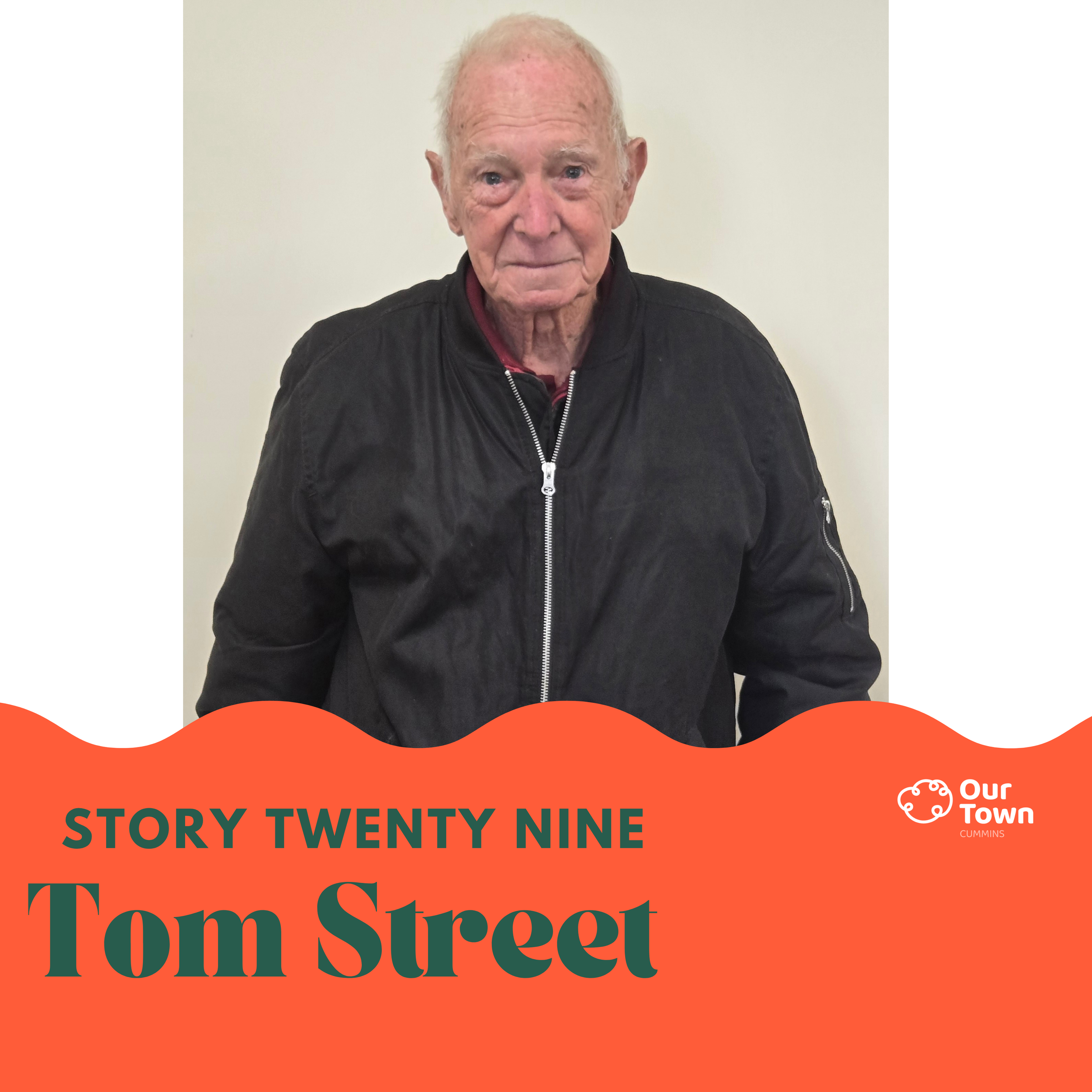
Tom Street
I was born in 1935 in Tumby Bay. There were six boys and one girl in my family. My father was a "ganga" in the railways. When he went to war in 1939, we moved to a house in Yaninee. I started school in Yaninee.
When we shifted down to Port Lincoln, I went to the Port Lincoln Primary School. We rented a house with an acre of land and Mum bought a couple of cows. We used to milk them in the morning and deliver the milk on the way to school. The walk was two miles each way. We’d pick up the billy can and money on the way home.
Every penny counted. I lived through most of the depression and the war. While the war was on, Mum got dad's pay and we could live all right on that. Dad never came home after the war. When the war finished, there was no pay and she had to get a job. Poor old mum, she had a pretty tough life. We just had to battle on.
I never ever knew much about Dad, only he worked at Poochera cutting scrub. I only found out later that he was a Barwell boy. I have a big heap of letters home that he wrote to the premier of South Australia. Theres a plaque at the Railway triangle for the Barwell Boys.
We used to get the cane at school. I got it quite often, like all boys. If you got one spelling word wrong, you used to get one hit on your hand. It would sting for a little while. If you got four words wrong you got four whacks. They would not hit you on the hand you wrote with, so it didn't interfere with your schoolwork. They were pretty cunning. They would just give you the cane whenever they wanted. It was a pretty rough time.
I got picked in the SAPSASA team and went to Adelaide for football. We were there for over a week! We were a primary school playing high school kids over there. We never even look like beating a team. We went over and back to Adelaide on the old Minnipa (MV Minnipa).
I was only 13 when I left school. I couldn't get on there and there was just no money. No one had money back in those days. My uncle George and Auntie Lil were at Kapinnie and said to send me up to work on the farm. I went and worked on the farm for five shillings a week and my keep. That was big money back then. I worked there until I was 15, when I thought about getting a different job and make a bit more money.
I got a job at Deep Well Station in Streaky Bay and was there for 12 months working on my own most of the time. It was too lonely. I worked seven days a week, checking over the sheep and the water troughs. Everywhere you went, you'd be running into kangaroos. I had one dog killed with the kangaroos out there. I always had two dogs and a horse, go out for a couple of days and then came back. I learnt to ride a horse on the station. I got bucked off once and broke my arm, so I had two months off back in Lincoln on full pay.
When I was 18, I was called up for national service, and I was at Woodside for three months. For the next two years we went for two weeks every year. We went to El Alamein and were the first ones there. Our job was to put the tents up and set up for the mob to come in. Most of them were city lads. I was the only country boy there. Not one of them knew how to drive a truck, tractor, grader or bulldozer or anything like that. We had to make roads and flatten the country to put all these tents up! The bloke in charge was a sergeant and very pleased I was off a farm and knew how to drive them. I ended up teaching them.
When I came back, I shifted to Cummins and worked for Fred Borgas for 18 months at Urano. When I got my license, I didn't have to sit for any exams, and I could drive any vehicle. I was only 16. I just came into Cummins one day with a load of bagged wheat for Borgas to go on the siding and thought I better go into the police station to get a license. He asked why I wanted one, and I said, "I'm working on a farm, and I got to cart wheat." He said, "No worries," and asked where my vehicle was. I mentioned it was parked outside, I didn't know any different! “Oh”, he said, "All right- where did you come from?” I said Urano, so he signed the paper and said I was doing all right.
I played football for Cleve on the Centre wing when I was working on a farm for 12 months. One night I was working in the paddock and did not finish until two in the morning after having machinery issues. I did not even have time to have a shower that's how buggered I was. I got up at around nine and went into Cleve to play footy all afternoon. The stupid things you used to do when you were young. I had the energy to do it. And you could do it.
I also played football for Marble Range for five years when I went to Lincoln. I was a part of their first grand final after the war. I went to the premiership 50-year reunion and there was only 12 of us left of the team. They took a photo and sent it to us. There were no photos or medals back then. Every one of the young players walked up and shook our hands and spoke to us. They gave a good speech about it. It was a good night.
When I was 20, I joined the South Australian railways. I started off as a cleaner and all you did was clean the engines. With the steam engine, we used to get in the firebox and clean the stays that used to let the water go through, to keep it cool. From there, I qualified to go out on the shunter, which involved shunting in the yard trains and in the loco. I moved to the main line and worked there for two or three years until I qualified as a driver.
While I was in the railways I went to Thevenard quite a few times. That was a long trip, 11 hours each way from Port Lincoln. We used to go up on a Tuesday, and you wouldn't come back until Friday. We would be sent out to Penong, drop off stuff, and come back again. I worked at Lock for three wheat seasons, and we used to go up to Wudinna and back each day. When I came back to Lincoln, a job at Cummins came up.
I had a good time in the railways. On each train there were two crew with three men on each. We would go away for four days. We used to go to Kimba, and then on to Buckleboo, back again. It was a goods train, we used to stop at every station, and we used to pick up truckloads of sheep and cattle and all that sort of thing on the way back and deliver it to Lincoln abattoirs.
When I was living in Cummins, I would work out at Kapinnie. It would have taken about three to four hours to get there. We used to take the train out backwards so you could pull the load forwards coming in until they put a triangle at Mount Hope. There was one at Yeelanna, too. It meant that you could turn the trains around, and then you'd come back, pick up your load from there what they had loaded.
You had to be fit and on the ball to fire engines, because you were shoveling all the time. You had to know the line as much as the driver. If a hill was coming up, you had to shovel more to keep your steam up. They didn't have gears, just a big wheel, and the wheel was put to where it was economical for running. Coming to the hills, it would need to be wound down a couple of winds, until you got your right tempo. A lot of people have never seen anything like it, and they probably never will again. The engine used to be in the playground in Port Lincoln, until a kid jumped off and broke their arm, so they had to get rid of the engine. The engine is now in the Pichi Richi. I got a free pass to go up on the Pichi Richi as I used to fire the engine. I had to sit with celebrities, members of parliament, mayors, and all that.
I was in Cummins for three years. I used to live in the seven sisters down the road (Railway Cottages). The first one housed the guard; I was in the second one. The clerk in the third, electrician in the fourth, and in the fifth was the fireman. There were different other blokes from the railways in the others. When the diesels came, they took all that away. It was a lot more work with the steam engines.
We used to go out on ballast trains and put ballast out for upkeep. I was in Lock for three months and then I went to Darke Peake. They'd bring loads of ballast from Lincoln, and we worked from Darke Peake to Kimba and back. It was all in steam engines.
All the sidings had a little sheep yard with a ramp. We used to pull the train alongside, the sheep truck or a cattle wagon was up level with the door; they used a plate that dropped down from the ramp and drove them up. Most times it was nighttime when you were doing it in the dark, we didn't have torches only a sludge light, which was run with kerosene in a little can and wick. Some days the stock gave us trouble.
All the groceries used to come on the trains or the rail car. There were no trucks to deliver stuff to the shops. The train or rail car used to stop at the shop in Edillilie. There was also a shop in Wanilla. These little places had shops, because there was no other place to go and get your groceries. People would order stuff, and they'd get it up by rail. "Takeouts” I used to call it. Every siding had a little shed. It wasn't a lock up shed, and it had a seat in there for passengers to sit on. We stopped at every station just in case there was stuff or passengers to pick up. The guards knew what takeouts had to go where. On the way back, we'd be picking up cream and eggs to go to the butter factory by the Boston Hotel.
A lot of people used to ride on the rail. Curtis's was the cafe here at the Cummins Railway Station. We used to stop for 10 minutes most times. People would go and get sandwiches or cups of tea or coffee. We 'd stop at Lock at the baker shop, which was just across the road, and they'd get pasties and things from over there too. There were all different places to stop, but Cummins was the only one that had a little cafe.
I worked at the silos too. I would work day shifts in railways and go and work 12 days in the nighttime. We were building them, starting from right from the bottom until they got to the top. I was a "steely" leaning over the side putting steel together to go in between the two lots of concrete. Ninety feet looking down, there's always a platform to walk up from the top. It was a scary job. It was good money. Sometimes the next day in the railways we would go to work, sit in the firebox, and make out we were working and go to sleep.
I used to wear coveralls. It was hot in the engine! When I was up at Thevenard, it was 40 something degrees in the sun, and your old canvas water bag hanging on the side of the engine was just nearly as hot as the sun. It was hard work.
We had to wash them ourselves. In Cummins the washing shed was down in the back, not in the house. The toilet was down the back too. The bathroom in the house and hot water was through a chip heater. You had to put chips of wood in it. It had to be lit up for a while to get the hot water going every night. There was an open wood fire in the lounge in the house. You had to go and get wood, or good wood delivered just to keep everything going.
I've been around a bit, and stationed at quite a few spots, moving trains around. That's what happens in life. And things come and go. I'm still alive. That's the main thing.
I used to be away a lot. The wife used to take the kids back to Lincoln with her mum and dad before they went to school. That was one of those reasons why we left Cummins for the kids to start school in Lincoln. We thought we're going to be there for a lot of years.
When people started getting cars and small trucks started on the road, there was talk about cutting the goods trains. We could see the writing on the wall. A lot of crews had to go. We had 32 engine crews in Lincoln at the time. You can imagine how many engines were going out of Lincoln. I stayed there for a while and then the wife said she wanted to shift to Adelaide for the kids to get a better education. I got a job in waterworks, which was a transfer from one good government job to another.
I worked at the pumping stations at Clapham & Clarendon. Eventually they made them all automatic and went as an inspector in the pump stations. They gave me a van with Two-Way radio in it. Most of the time I was just driving, checking the stations to make sure they worked properly.
I worked there until I had a triple bypass after a few heart attack scares. I wasn't that old. I had to retire from the water work because I just couldn't do it, couldn't keep up with it. I've been on a pension ever since.
I have three children, a boy and two girls; Greg, Shelley and Cindy. They have all retired now. I’ve got four grandsons; Greg's got one, Shelley's got one, and Cindy's got two. The kids have all done well, and I am glad they all have.
The kids were never told what I was doing when they were little. They only knew I worked in the railways. They used to go for rides when they were small out to the cross at Karkoo with me, where they would change over the railcars. They thought that was great.
My wife and I split up after 30 years. I came back to Cummins and lived on my sister and her husband's farm, for three years. I met Thelma in Cummins one day. It was at her daughter Trish’s place, and it went from there. Wasn't even looking for anything. I've been married to Thelma for 22 years. We had a garden wedding in Adelaide.
I'm a step grandfather. I'm the only one that she's known as a grandfather, and she wanted me to walk her down the aisle; it was pretty special. She was happy to have me do it. It was in Gladstone,
I took on cutting wood. And I've been cutting wood right up until I was 89 before I stopped. I'm coming up 91 now. We used to bring trailer loads back to our yard in Cummins, and we had a big stack of wood. We were doing anything from 60 to 80 tonne a year. I sort of miss cutting wood because I'm not fit anymore. I was fit when I was doing that.
A few months ago, they had to stop my heart here in Cummins and start again. One night, I was getting chest pains, and we made our way up to the hospital. I did not realise how bad it was, Thelma had to come in, they didn't know if I was going to survive. I only had one option, that was the paddles. So, they stopped my heart. I didn't know what was going to happen. I just said goodbye to everybody. I couldn't say goodbye to any of my kids. I came to a little while later, I didn't know where I was, didn't know what had happened. I survived, and I'm feeling right now.
Nowadays I just take it easy, trying to relax. It gets a bit boring at times. I go up to Streaky Bay and enjoy a bit of fishing. I just look after my garden now. I still enjoy going to RSL. I've got chooks and give quite a few eggs out. We used to take eggs to Lincoln every Sunday and that was buying the chooks food, I like my chooks. My niece comes in and looks after me. She lives in streaky Bay. She comes down here and runs everything for me. I'm pretty lucky.
We have our 8-year-old dog Pancho. He’s three quarters chihuahua and something else. He chases all the blackbirds at home. I don't want to take him away from home. He walks as far as the gate. I can go down the street and he won't go anywhere. He sleeps in the laundry every night. Comes in of the morning when I open the laundry door and jumps all over me. He goes mad with visitors; he just loves people. He is a lovely little dog. He has a couple little chocolates in the morning and some of those doggy strips. He’s happy and in very good condition. I sit on the arm chair at home and he’ll sit with me for hours. He lies on the bed until 10 at night and he knows to go off to his own bed. He even rounds up the chooks- gets them in the yard pretty quick- he's a chook dog. He’s a character.
I’ve had a fairly interesting life, really. So many different things have happened, and I have seen a lot of things. There’s been ups and downs, you have your good bits, and you have your bad bits. I've enjoyed when I've been living here, Cummins again.
I'd like to see the train running back tomorrow, I love the old trains.